ASERA / EVENTS
Events & Milestones
Following the moments, missions and discoveries shaping astronomy and aeronautics.
FEATURED EVENT / NOVEMBER 2026
One light-day.
One extraordinary journey.
NASA's Voyager 1 is approaching a distance no human-made spacecraft has reached before: one light-day from Earth. Nearly five decades after launch, humanity's farthest explorer is about to cross a remarkable new threshold.
ASERA joins the global celebration with a video tribute to NASA's “Shine Bright for Voyager’s Light-Day” initiative.

ASERA VIDEO FEATURE
Shine Bright for Voyager
A tribute created by ASERA in celebration of Voyager 1's one-light-day milestone and NASA's invitation to send a symbolic message of light toward the farthest human-made explorer.
Video: ASERA. Original 4K upload converted to a web-compatible H.264 version for smoother playback and hosting.
THE MILESTONE
What does one light-day mean?
A light-day is a unit of distance: how far light travels through a vacuum in 24 hours. It is about 25.9 billion kilometres (16.1 billion miles). At this distance, a radio signal travelling at the speed of light takes a full day to reach Voyager 1 — and a reply takes another day to return.
NASA's current projection places the milestone on 18 November 2026 at 05:16:07 EST (12:16:07 in Bulgaria, EET / UTC+2). Voyager 1 will become the first human-made object to reach this distance from Earth.
Launched on 5 September 1977, Voyager 1 explored Jupiter and Saturn before continuing outward. In August 2012, it crossed into interstellar space, becoming the first spacecraft to do so.
17 NOVEMBER / AFTER SUNSET
Shine Bright for Voyager’s Light-Day
NASA’s invitation is more than a countdown to a distance record. It is a shared, symbolic salute from people on Earth to a spacecraft that has been travelling through space for nearly half a century. After sunset on Tuesday, 17 November 2026, NASA invites participants around the world to shine a light skyward and flash VGR — the Voyager mission call sign — in Morse code.
NASA/JPL-Caltech. The graphic spells out the Voyager mission call sign: V (···−), G (−−·), and R (·−·). NASA’s original campaign artwork, included here as the visual guide for the worldwide celebration.
How to send the light signal
Use a flashlight, phone light, lantern, or another safe light source. Point it upward and switch it on and off to form the three letters. In light-based Morse code, a dot is a quick flash of less than a second; a dash is a longer flash of about one second. Pause briefly between the letters, then repeat the sequence for around a minute.
V: three short flashes, one long flash. G: two long flashes, one short flash. R: one short flash, one long flash, one short flash.
NASA also offers an automated V-G-R flasher that can be opened on a phone or tablet. The campaign is symbolic: a flashlight or phone screen is not a practical radio transmitter, and this light signal will not reach Voyager 1 across interstellar space. Its meaning is the shared gesture — millions of people on Earth acknowledging humanity’s farthest explorer.
NASA encourages participants to photograph or record their signal and share it on social media, tagging @NASA. Please take care to avoid shining bright lights into aircraft cockpits, vehicles, or anyone’s eyes.
NASA: Official celebration instructions ↗ | Open NASA’s VGR flasher ↗
MISSION ARCHIVE / NASA & JPL
Voyager 1: The spacecraft and its legacy

NASA/JPL-Caltech artist's rendering of the spacecraft and its science instruments. Original image and details ↗
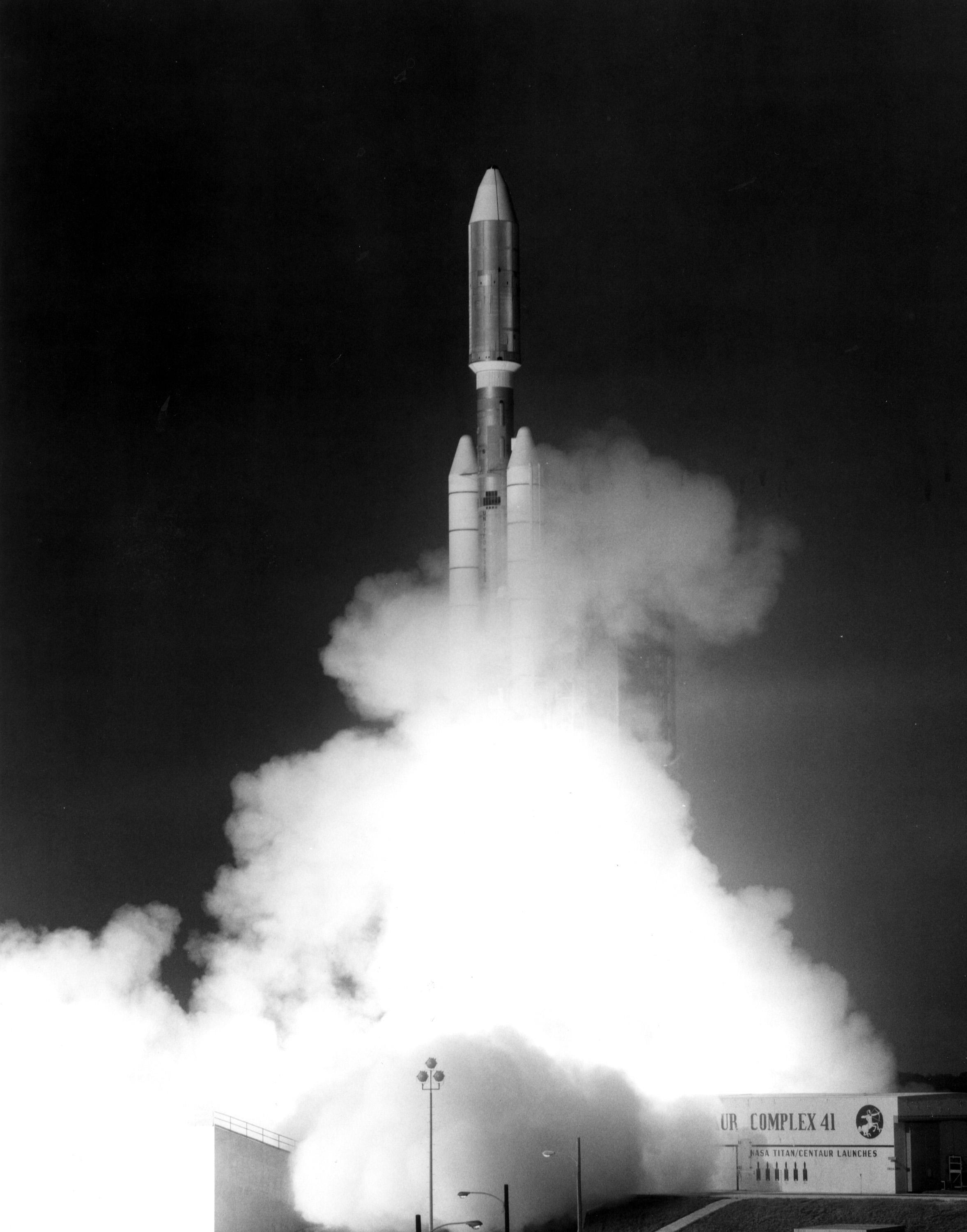
Voyager 1 lifts off from Kennedy Space Center. Credit: NASA/KSC. Original image and details ↗

A 12-inch gold-plated record carrying sounds and images from Earth aboard both Voyager spacecraft. Credit: NASA/JPL-Caltech. Original image and details ↗

Earth photographed by Voyager 1 from the outer Solar System in 1990. NASA Voyager 1 mission page ↗
CONTINUE EXPLORING
Follow the Voyager mission
NASA continues to publish mission status, spacecraft position and science updates. The links below lead to the official mission resources used for this feature.